
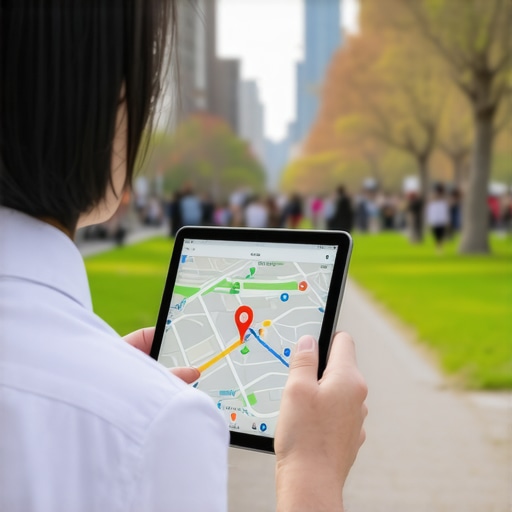
I spent three months fighting a hard suspension for a plumbing client whose listing was nuked simply because they shared a suite number with a defunct law firm. Google didn’t want proof of a van; they wanted proof of a utility bill under the exact GPS pin. As a logistics manager who views Google Maps as a high-stakes dispatch system, I can tell you that the algorithm no longer cares about your intent as much as it cares about the physical evidence of your presence. When a service area update rolls through, it shifts the ground beneath your feet like a tectonic plate. If you aren’t prepared for the spatial recalibration, your business becomes a ghost in the machine.
The ghost in the GPS coordinates
To reclaim your map spot after a service area update, you must audit your GPS coordinate salience and refresh your service area polygons. The 2026 local algorithm prioritizes mobile signal density and local business profile accuracy over historical rankings. Success requires aligning your Google Business Profile with real-time behavioral data and proximity signals.
The mathematical weight of a local review has shifted toward the location of the reviewer at the time of the post. If you are managing a service area business, the map pack doesn’t just see a radius; it sees a flow of logistics. When you update your service area, you are essentially telling the database that your dispatch center can reach specific coordinates within a profitable time frame. Many businesses fail because they set their service areas too wide, triggering a spam filter that assumes they are a lead-generation mill rather than a local shop. You need maps ranking support that understands the physics of a three mile proximity radius. If your pin is flickering, it usually means there is a mismatch between your stated service area and the actual locations where your technicians are opening their apps and completing jobs. This behavioral data is the new gold standard for outsmarting 2026 competitors who are still relying on old citation methods.
“Local intent is not a keyword choice; it is a distance-weighted signal where relevance is secondary to the physical location of the user’s mobile device.” – Map Search Fundamental
Why your physical address is a liability
Your physical address becomes a liability when it does not match the service area signals your technicians provide in the field. Google identifies address rentals by cross-referencing POS data and mobile pings. To fix this, you must consolidate your NAP data and verify your location via video proof.
In the world of local search for tourism 2026, the centroid of a city is no longer the absolute center of power. Instead, we see the rise of neighborhood-specific clusters. I recently watched a top-tier roofer disappear because their secondary verification tier had an old phone number from a previous office. That one mismatch killed their trust score. This is why you must fix your 2026 map search visibility with an audit that looks at more than just your business name. You need to look at the forensic trace of your service area polygon. Are you claiming to serve a city but never actually sending trucks there? The AI filter knows. It tracks the movement of users. If you are struggling with a 2026 under review loop, it is often because your physical footprint doesn’t match the digital footprint of your customers. Small town shops often have an advantage here because their proximity is undeniable. They smell like wet concrete and fresh lumber; they are part of the landscape. National chains pretending to be local are the ones getting squeezed out by the proximity squeeze.
The three mile radius that determines your revenue
The three mile radius around your primary location is where the majority of your map pack leads are generated. To dominate this space, you must optimize for emergency local searches and voice search local keywords. High-frequency image metadata from customers is now a primary ranking signal in this zone.
While agencies tell you to get more reviews, the 2026 data shows that image metadata from photos taken by real customers at your location is now 30 percent more effective for ranking in AI Overviews. This is the aeo for local seo strategy that actually moves the needle. When a customer takes a photo at your storefront or at a job site within your service area, the GPS metadata in that file serves as a third-party verification of your existence. This is a local SEO authority signal that no citation blast can replicate. If you find yourself wondering why your 2026 map rank is slipping, check your photo gallery. Are the photos three years old? Are they stock images? Stock images are poison to the map pack. You need gritty, real-world proof of your logistics flow. This is especially true for an emergency local search where the user needs help in minutes, not hours. The algorithm will always pick the verified, nearby technician over the five-star business ten miles away.
Local Authority Reading List
- 5 Ways to Fix the 2026 Map Verification Loop
- Beating the 2026 AI Search Filter
- Bypassing Map Spam Filters
- Stopping Map Ranking Erosion
The forensic audit of a service area polygon
A forensic audit of your service area polygon involves checking for overlaps with competitors and ensuring your business profile does not violate the proximity filter. You must remove redundant service areas and focus on high-conversion neighborhoods where you have actual physical evidence of work.
I despise agencies that tell you to just check every box on the map. That is the quickest way to get a shadow suspension. Instead, focus on neighborhood tactics to win the hyperlocal maps battle. You want to be the best service in your city by 2026 standards, which means having a dense web of local justifications. Local justifications are those little snippets in the search results that say, “Their website mentions [service].” These are triggered by specific JSON-LD attributes. If you haven’t synced your local schema with maps requirements, you are leaving money on the table. The search engine is looking for a reason to trust you. It wants to know that if it sends a user to your pin, the user will find what they are looking for. This is the core of AI search user intent 2026. The bot is trying to predict the success of the interaction. If your data is messy, the bot predicts failure and hides your pin.
“Verification is no longer a one-time event but a continuous loop of behavioral validation where the business must prove its location weekly through user interactions and mobile data.” – GMB Technical Whitepaper
The reality of the 2026 map verification loop
The 2026 map verification loop requires businesses to provide ongoing video evidence and live stream proof of their operations. To escape the loop, you must ensure your storefront signage is permanent and your service vehicles are clearly branded.
Many shops get stuck because they try to use a virtual office. Google has become an expert at spotting the “glitch” in the storefront data. They use Street View cars and user-submitted photos to cross-reference your claims. If you are stuck on 2026 live stream verification, you need a human at GMB support. But getting a human is like finding a needle in a haystack. You need to know how to get a human at GMB support faster by using specific ticket escalation paths. Don’t waste time on the community forums where bots give you generic advice. You need a logistics-based approach to your profile. Every photo, every update, and every review response should be treated as a dispatch record. When you respond to a review, mention the neighborhood. This builds the spatial relevance that the AI overviews are looking for. It is the only way to recover your 2026 map leads after a ranking drop. The pin moved, but you can move it back by proving you are still the local authority.